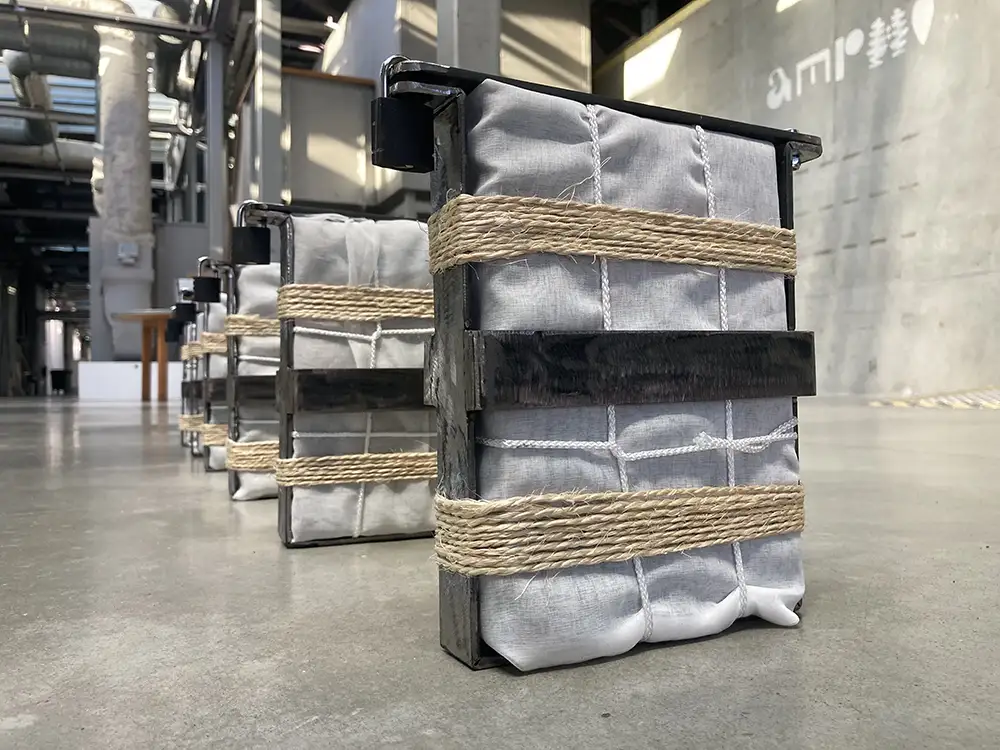
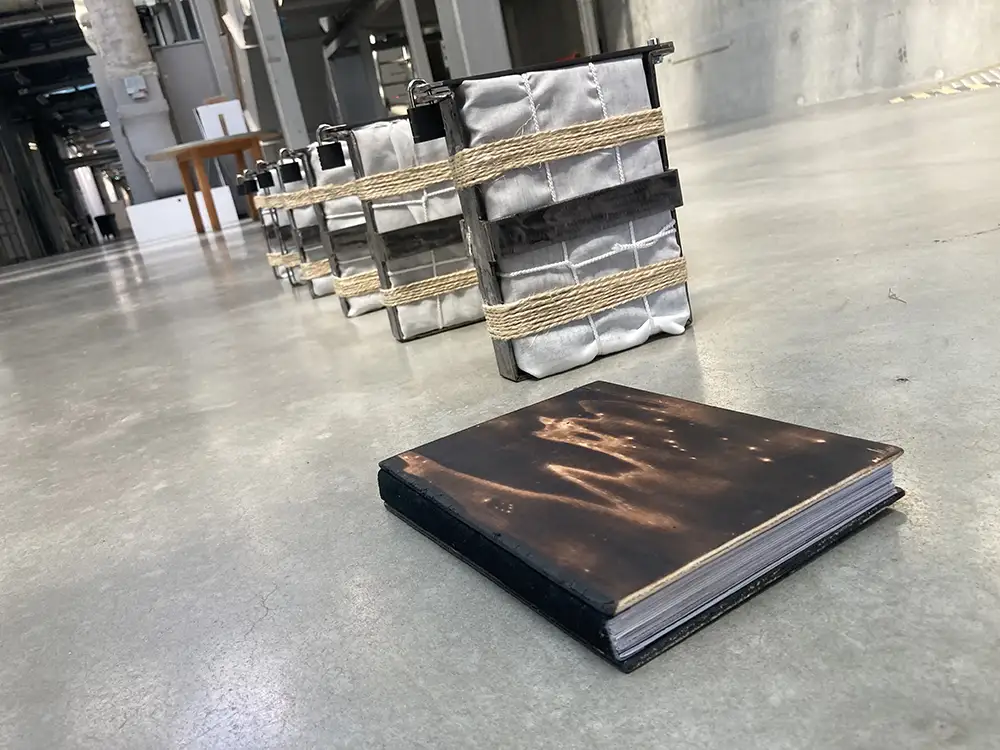
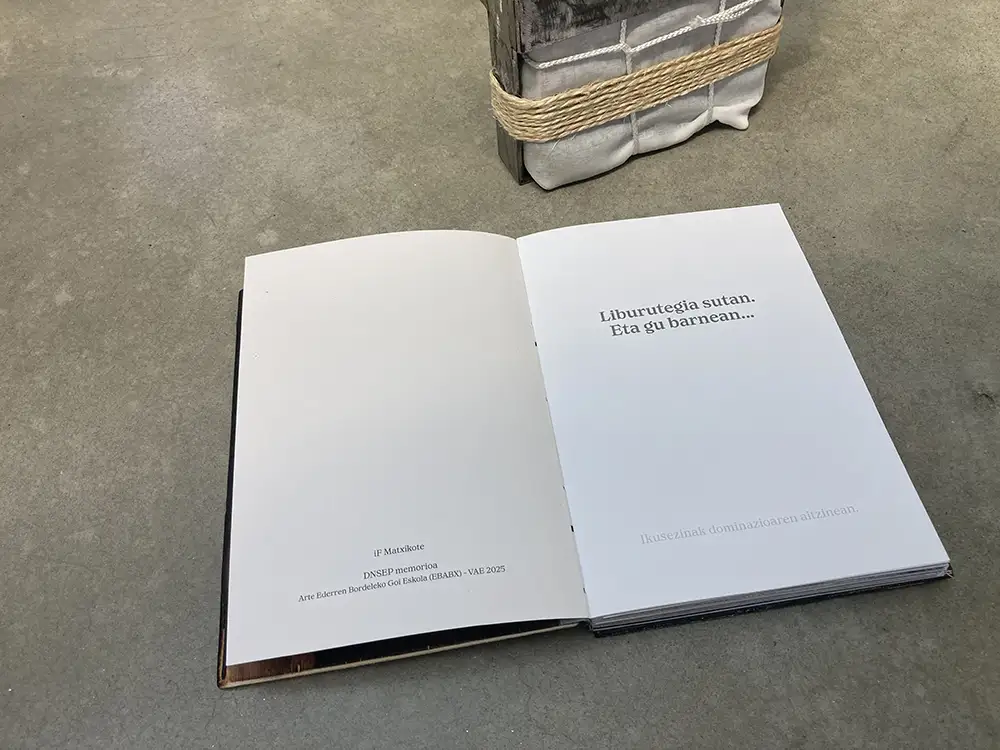
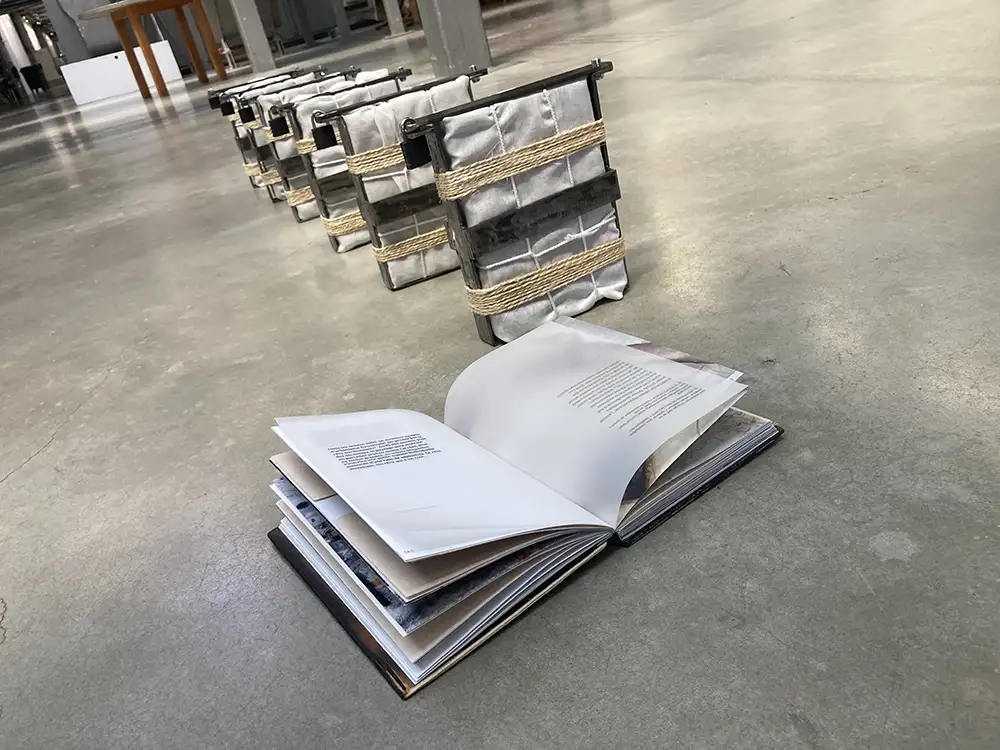
This is the second part of the dissertation submitted for DNSEP validation, which gives an idea of the subject that guides my work. Although it was written for the Diploma in spring 2025, it is still relevant today. The dissertation can be viewed below.
I have been baking my own bread for three and a half years now. I started doing it because I no longer wanted to go to the bakery only to return home with a knot in my stomach and no bread…
Everything was normal. Well, that kind of normality that one learns to endure. That morning, however, approaching the counter from which emanated that typical and comforting smell of warm bread, I asked, with my index finger raised: "— bageta bat mesedez" ("— a baguette please" in the Basque language). The saleswoman snapped back immediately: "— Whoa! I'm not Basque!". In a pedagogical manner, and knowing that the sentence contains only three words of basic vocabulary related precisely to the person's professional activity (I could have even used a synonym further removed from the French version of "baguette"), I insisted "— bageta" while pointing to the loaves, then "— bat" while showing my index finger, straighter than the Tower of Pisa. Placing the coveted product on the counter, she threw at me: "— Me, the Basque language, no interest!". I took my money back, turned on my heel, and, leaving her the baguette, left. Even buying bread can become violent.
The question of language is important. I belong to that first generation to whom it was not transmitted in the family context—the last true bulwark before the fateful event: its disappearance. If I learned it at age 20, it was to use it and therefore, given its administrative situation, to defend it; not because it is more than any other, but because it is, it exists, and has the right to endure. This is also why I have integrated it into my work, in one way or another.
Public action in favor of non-official languages in the French state seems irreproachable, as its effectiveness is supposedly indisputable in the results. Flattering speeches flow from all sides and the figures provided fill one with hope. Because figures matter.
According to the report covered by the journalist from ICI (France Bleu) Bixente Vrignon, for the 2023-2024 school year, 43% of students in Basque territories were schooled in the Basque language. What a figure! some will say. Yet, we can see that, conversely, 57% of students will have no relationship with the language of the territory where they live.
As for that 43%, since only primary school students were counted (combining bilingual and immersive teaching), it no longer held up. On the other hand, when we know that, out of all students that year, only 6% finished their schooling after following an immersion curriculum—and that they alone were certainly capable of holding a discussion in Basque—this gives us a figure of 94% of children unable to express themselves in the language (of whom 68% could be our bread seller). The panorama is markedly different, and the euphoria vanishes instantly.
"Wretched creatures, cast for a moment upon the surface of this little heap of mud, is it then decreed that one half of the flock should be the persecutor of the other?"
— D.A.F. de Sade, Letter to Miss de Rousset, Philosophical gifts, 26 January 1782.
A language is not a living being. It is not a separate, independent, and physical thing. Language is part of us. It is the preferred means of communication invented by a human community. There is nothing genetic about it, and it can be learned by anyone.
We live through language. Thus, the linguist Antoine Meillet specified at the beginning of the 20th century that "language has as its first condition the existence of human societies of which it is, for its part, the indispensable and constantly employed instrument." We communicate, certainly, but we also think, reflect, and dream with language. Thus, when we talk about language, we are talking about speakers, human beings—beings endowed with feelings and emotions. To deprive a population of the learning and knowledge of its language is also to deprive the other part of the population, which is increasingly marginalized, of the ability to practice it. In addition to the consequences for the language, this has psychological and emotional consequences for the speakers.
The Belgian political scientist and researcher François Gemenne tells us that natural disasters do not exist, because everything depends on numerous criteria and conditions of exposure. The data relating to education cited above cannot be the result of chance, nor of the choice of a population that decided on its own that its children would not learn its language. There are contemporary, political, and sociological conditions for this, but also a history—something that was built, and which at the same time destroyed.
We can go back as far as 1609, when the magistrate Pierre de Lancre was sent from Bordeaux to the territory of Labourd to carry out a witch hunt. Contempt for culture, rites, and, of course, the language was the excuse to torture, condemn, execute, and even send at least a hundred innocent people to the stake. De Lancre, as Julien Vinson reminds us, attributed to the victims the marks of their culture, such as drinking cider—the "fruit of perdition"—dressing in too particular a fashion, and having no fear of the sea… Through these trials, terror was quickly spread. The most tenacious would continue to practice their rites and customs in hiding, but many would already begin to reject their own identity for fear of reprisals and to save their lives.
This dark episode was followed by others. However, there would be more pernicious ones, such as the use of an object taking various forms (a ring, a small stick…) called the "Anti." This object was a means of pressure on children to denounce a classmate who spoke in Basque, thus passing them the "Anti" and avoiding punishment at the end of class. It was a tool for "education" in denunciation and the rejection of the language for children henceforth obliged to go to the school of the Republic.
In this same spirit, the President of the French Republic, Emmanuel Macron, confirms the state's contempt for non-official languages. In his declaration delivered during the presentation of the 9th edition of the Dictionary of the French Academy, he asserts that "vernacular languages," "patois," "regional languages"—in short, all those languages that do not seem to be languages in the eyes of the state—"were an instrument of division," he tells us; languages that, for some, have existed for millennia… Indeed, natural disasters do not exist.
Far be it from me to focus only on the fate of the Basque linguistic community, for the problem is of a much greater magnitude. We are witnesses, for those who care to see it, of a generalized mass extinction. This mass extinction is precisely the subject worked on by the trio Diller Scofidio + Renfo in partnership with the philosopher and urbanist Paul Virilio for the exhibition "Native Land, Stop Eject," organized by the Cartier Foundation for Contemporary Art.
EXIT. This is the name of the video installation they created. In this work, a wealth of data is used concerning migratory and economic flows, and the causes of each. There comes a moment when the question of languages is addressed. As renowned linguists like Nicolas Tournadre (CNRS researcher) have already pointed out, we are witnessing a dynamic presentation of the massive disappearance expected to occur during this 21st century: namely, the extinction of 47% of the 6,700 languages still existing today.
As early as 2010, Charles Sandison created a commissioned installation at the Musée du Quai Branly titled The River. He invited visitors to be carried away by a river of words representing the 16,597 names of peoples and geographical locations present in the museum. The idea was to show human diversity and the richness of cultures. The museum's intention is laudable, but the daydreaming is cut short when we know that, as Bertrand Westphal points out, some of these places are now nothing but ruins and many of these cultures are endangered or already extinct…
As we have seen above, language is intrinsically linked to the individual, to their connection with their cultural community, and to their identity. It immediately differentiates a culture. Europe was rich in them. Moreover, languages have no evil intentions, as De Lancre supposed in the 17th century, nor political intention in themselves, as the French president still supposes in the 21st. On the other hand, their disappearance—a consequence of contempt, condemnation, exile, and deportation—and their replacement by another presented as superior, suggests rather an intention: that of domination.
Bertrand Westphal reports the case of the Anglicization of Gaelic toponyms, resulting in the direct loss of meaning of these names and clearly expressing the will to "colonize at all costs and in all directions." Our Limousin academic, of Alsatian origin, sought an example across the Channel when the French Republic is an indisputable model of it.
Culture, however, is only one aspect linked to the process of domination. It is one of the spearheads of hegemonic aspirations. It is encompassed in a global political vision of our societies where land-use planning is perhaps not as innocuous as one might think.
In the 1960s, a new model of functional urbanism was promoted by the "suburban dream." Over the years, then decades, the landscape would be broken up into more or less square plots, in the middle of which would be a small individual house surrounded by a hedge of cypress trees. The American dream. A dream that has a cost.
Unai Fdez de Betoño, an architecture teacher at the University of the Basque Country (EHU), conducted a study on the relationship between urban organization and language. This study shows how this model is based on the business of certain sectors: construction companies, the automotive sector (and fuel production/sales), road planning, and of course, insurance and banks to finance it all. While the individual house becomes a symbol of success, it creates a growing dependence on the system. This dependence is associated with isolation, as local social, economic, cultural, and linguistic ties are hindered and broken. The TV presenter becomes the friend of the family, withdrawn into itself in an era of "social deconstruction," to use the words of Paul Virilio.
Beyond social, economic, political, cultural, and linguistic aspects, this expansion of a "city that is not one" accentuates the artificialization of the soil. This directly affects environmental balance and biodiversity. Agricultural and natural lands are redefined as buildable, and natural spaces vanish like a "shrinking skin." The earth is no longer anything but an object on which lines are drawn, zones are defined to then do business, as Jenny Saville presents in her work titled "Plan": a woman's body (her own), an object ready for liposuction to meet an aesthetic imposed by the masters of a game. This conquest of the "Other" has taken place and continues on a larger scale, in the name of Civilization and its vocation to spread the Universal.
The universal… It is in its name that conquest and domination took on a global scale a few centuries earlier. On this subject, Bertrand Westphal reports the reflection of François Jullien, for whom this reference to the universal would be the pretext for a nuance-free uniformity stemming as much from a laziness of spirit as from a hegemonic voluntarism.
Laziness of spirit. The dictionary of the French Academy gives this definition: "Habitual disposition not to work, nonchalance, negligence of things." Seeing the enthusiasm and frenzy with which the states of Western Europe struggled to colonize the world and impose, among other things, their universal vision, we might doubt the accuracy of the descriptor. But it is true that, considering themselves the heirs of the Enlightenment—and thus supposed to go against obscurantism—we may question their laziness in being at least consistent.
Long before our landscapes became green squares with white dots, European powers attacked the large expanses of greenery that were the other continents to them. And the inhabitants of these regions? Merely sub-species useful for forced labor… If there was light, it was brief or very weak… Our so-called civilized, civilizing societies have, in any case, no complexes. They take themselves for the model, but beware: the student must not follow the example, or there will be punishment. And punishment there was for all those leaders of peoples who had rebelled and were condemned to deportation, from Africa to the West Indies or elsewhere. Christine Delphy, for her part, bitterly remarks that the West does not question its responsibility and that, faced with protests against injustice, it reacts by doubling down.
Imperialism and ethnocentrism, even European, is clearly racist. Colonialism subordinates the Other. It occupies their territory, uses them as labor, exploits their resources, yet tells them—in the case of Senegal, for example—that they are French but without granting them equal citizenship… and, moreover, complains about an "invasion" of Africans on its metropolitan territory… Laziness of spirit seems to rhyme with bad faith. Jean-Paul Curnier emphasizes the fact that these empires which call themselves Democracies result from a conflict between the values they advocate and their practical plundering—a conclusion that Régis Debray would also agree with.
Kader Attia's work Ghost allows us to address a clear example of this contempt, which also takes on a symbolic turn: the debate over the veil. Here, the artist raises the question of identity in the face of collective devotion, of the balance between vulnerability and strength. However, to return to our subject, this work allows us to address multicultural relationships, religions included. Kader Attia is French and has dual French and Algerian nationality. We could say he stems from French colonial history. His parents lived in a so-called "French Algeria" where the majority faith is Muslim.
The metropole, for its part, while calling itself secular, maintains an obvious Judeo-Christian Catholic line. Large crosses in public squares have not been dismantled. Sunday masses are broadcast on public television channels, and the president even occasionally participates. We can also think that the banning of neither the cross nor the star took place, aided by tolerance regarding their "conspicuous" nature. So why a law "against the wearing of religious signs" which in fact only targets the wearing of the veil? The argument of secularism (laïcité) is once again difficult to accept… Christine Delphy offers a direct and sharp reading that allows us to glimpse the ambient intolerance of a debate that is censored from the start since the women concerned were never heard.
The consequence will be, in any case, the discrimination of thousands of young girls and a reinforced stigmatization of a part of society. The reason, for its part, is clearly suspicion and hatred of the other. And Bertrand Westphal again wonders "if the construction of the West's imaginary inevitably leads to a reactionary game of opposition, which aims to establish the superiority of the One—subsumed under a selective but vague 'us'—in relation to an Other stuck in an irreversible alterity." The barriers, the walls, are there—visible and invisible.
Agustin Perez Rubio, curator of the Spanish pavilion at the 2024 Venice Biennale, stated in an interview: "decolonization because colonization!". It may seem obvious, but the colonial past is not easily owned by former powers, and requests for apologies for the abuses they perpetrated are only just beginning to be expressed… "150 years too late," according to Almaz Teffera, a researcher on racism in Europe for Human Rights Watch.
Technological evolution and large-scale interconnection have their flaws but also have qualities, including the dissemination of alternative information. Associative, popular, and sectoral movements in favor of civil and political rights are multiplying and helping each other. Artists bring their contribution. Together, they help raise awareness on subjects that are minimized and sometimes obscured. This necessarily influences their treatment in larger-scale media. This is how we came to know the Black Lives Matter dynamic and see that the racist policies of the United States, taken as a model by Europe, still endure.
There are, however, those violences and tragedies that are not necessarily seen. Indigenous peoples disappear because their environment is trashed, exploited to total destruction to feed an economy without limits and devastating. François Gemenne summarizes it briefly: deforestation in the Amazon, real estate speculation in Argentina, desertification in sub-Saharan Africa, rising sea levels in island states of the Pacific in particular. One can understand that for peoples whose culture remains intimately linked to the environment, in respect for it, these changes are fatal.
However, stopping at extra-European native peoples too often takes on a turn of morbid exoticism, especially since the West likes stereotypes and quickly regains its supremacist colonial spirit. Empathy is the key, and the "second decolonization" called for by Ramón Grosfoguel is the way. A total, transversal decolonization to "lead to a racial, ethnic, sexual, gendered, and economic heterarchy." Bertrand Westphal would gladly add "cultural." The latter thinks, moreover, that it is thanks to the triggering of the decolonization process and its gaining of vigor that the universality of Western claims and its systematic spirit are beginning to be disavowed. Because it is indeed a system. We must avoid simplistic determinisms categorizing all white and European men as guarantors and fervent defenders of imperialist and patriarchal injustices. It is a system with its structures, its power, its values… and anyone can defend or denounce these values, whatever their gender, skin color, origins, and place of life. It is up to each individual to choose. Choose between what? Choose between despising everything that is different from oneself or respecting it as equal. Choose between dominating, crushing the other, or standing in solidarity with them. This problem does not only arise in a West/World relationship, which would in fact bring the "exotic" connotation I mentioned earlier. It arises in its entirety and everywhere. It is therefore natural to also question it within the European territory itself.
In her book To Classify, To Dominate: Who are the 'Others', Christine Delphy gives us an interesting reading on the domination of some over others. There is, however, a shadow over the picture insofar as she contrasts the experience of Bretons and Auvergnats—whom she includes, to use her words, in the "Franco-French" side—with that of young people of Maghrebian origin. Delphy herself was born in Paris. By this comparison, she gives us the impression of having well assimilated the vision of unity and indivisibility of the French Republic, and, in any case, of having no idea of what happened outside of Île-de-France.
It seems appropriate here to report extracts from a text that will allow us to take the measure of things. I took it from research by Julien Vinson titled The Basques of the 12th Century: Their Customs and Their Language, published in 1881. The passage is taken from the Liber Sancti Jacobi (Book of Saint James) and was reportedly written in Latin by a Poitevin monk named Aimery Picaud:
"It is a barbarian nation, different from all nations in its rites and its essence, full of all malice, black in color, unjust in appearance, wicked, perverse, treacherous, devoid of faith and corrupt, lascivious, drunken, practiced in all violence, ferocious and savage, wicked and reprobate, impious and austere, terrible and quarrelsome, uncultured in all things, practiced in all vices and all iniquities, similar in malice to the Getae and the Saracens, hostile in all things to our Gallic nation. For a single coin, a Navarrese or a Basque destroys a Frenchman, if he can. And if you heard them speak, you would be reminded of the barking of dogs."
Certain words become, over time, the breeding ground for irreversible acts and, with these bases, one could find it normal that 500 years later, this thesis—reinforced by a few additional "illuminations"—becomes the indictment of a witch hunt cited previously.
Christine Delphy proposes that all discrimination be included in the concept of racism, whatever the field. She highlights effects comparable to any negation—often accompanied by hostility and violence—on material life, the conception of life, trust in others, optimism or pessimism about the future—in short, on self-esteem. She adds that these effects, accumulated after years of daily humiliation, are not taken into account by "the 'great' French specialists of racism." I agree with her and believe that the subject is indeed only partially addressed, even by Christine Delphy herself for the reason cited above.
The list of injustices done to peoples and cultures on the very soil of Europe could be long if we had to list them up to the present day, with laws being added, the unofficial taking precedence over the official, etc. It seems difficult here not to compare the racism suffered by communities resulting from colonization and immigration to that—hidden but historical—towards indigenous European cultures.
This is why I admire all those who stand up—oppressed or in solidarity—intellectuals, activists, and/or artists. And it is among them that I include myself and situate my work. So that everywhere, oppression may be unmasked and denounced.
There are no natural disasters and all human beings are not born free and equal in dignity and rights… May that change one day…

[]

[]

[]

[]